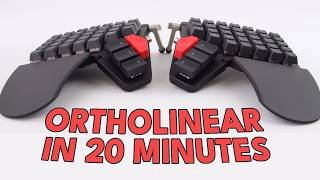
Are Ortholinear Layout Keyboards Actually Stupid?
Lewis switched from a row-staggered Dygma Raise to ortholinear split keyboards and discovered ergonomic benefits worth the painful learning curve.
Key Takeaways
- The staggered key layout on modern keyboards exists solely because of mechanical typewriter arm constraints from the 1870s, not because it is better for human hands.
- Switching to an ortholinear keyboard caused an initial drop from 70 WPM to just 26 WPM, but steady practice brought speed back up to 50-60 WPM within roughly a week.
- The split design of the keyboard was primarily responsible for eliminating upper back pain and shoulder tightness, while the ortholinear grid layout improved typing efficiency.
- Ortholinear and split are distinct features — a keyboard can be split without being ortholinear, and ortholinear without being split — but combining both offers the greatest ergonomic benefit.
- If you type comfortably with no strain on a row-staggered keyboard, switching may not be necessary, but persistent curiosity or physical discomfort are good reasons to explore ortholinear layouts.
- Customising your key layout on an ortholinear keyboard — moving keys to match your actual usage patterns — significantly accelerates the adaptation process.
Need to Complete High-Quality Creative Work Fast?
We're obsessed with making tools that help you FLY THROUGH your creative work! If you want to produce more quality creative work then you ever have before, then drop your email below and get exclusive first access to new products we launch, at HUGE discounts, all dedicated to helping you Complete Creative Work Faster
Full Transcript
Ortholinear keyboards are stupid. My friend said this to me a couple of years ago. He’d been typing on regular keyboards for over two decades and couldn’t understand why anyone would want their keys arranged in neat little rows instead of familiar staggered pattern that we’ve all grown up with. And honestly, I didn’t really have a good answer for him. I’d seen these keyboards online, the ones where every key lines up in a perfect grid, and I thought they looked cool.
But I couldn’t actually explain why they might be better or if they were better at all. So I took his statement as a challenge. I was going to figure this out for myself. But to understand why ortholinear might matter, I first had to understand why our keyboards look the way they do in the first place. And this is where things get a little ridiculous.
Here’s something most people don’t know. The staggered layout on your keyboard, the one where each row is slightly offset from the one above it. That exists because of a mechanical problem that was solved over 150 years ago. In the 1870s, typewriters had these metal arms called type bars. When you press the key, a type bar would swing up and strike the paper.
The problem was, if the keys were arranged in a straight grid, the type bars would jam into each other constantly. So Christopher Latham Sholes, the guy who designed the QWERTY layout, staggered the keys, not because it was better for human hands, but because it was better for typewriter mechanics. And here’s the thing. We don’t use typewriters anymore. We haven’t for decades, but we’re still using a layout designed around mechanical arms that no longer exist.
I’ll come back to why this matters in a moment, but first let me tell you what actually happened when I tried to switch. I got my hands on two awful linear keyboards. The ErgoDox by Zsa, which I have here. Kind of awkwardly, how do you show that? The ErgoDox by Zsa, this big, sculpted split keyboard with thumb clusters that look like they belong on a spaceship.
And the soffol chock, which I have over here. The soffol chock, a much smaller, more portable split board with low profile switches. Day one on the ErgoDox was really humbling. I went from typing around 70 words per minute with 96% accuracy on my old keyboard, the Dygma raise down to 26 words per minute with a lot worse accuracy. 26.
I felt like I was learning to type all over again. And it wasn’t just the Speed. It was worse than that. I write a lot of sales copy in my day to day work. My process is usually to free write a rough draft, just.
Just let my thoughts flow out onto the page without stopping, and then go back and refine it later. But with the ortholinear layout, I couldn’t do that anymore. I kept thinking about where the keys were. Every sentence got interrupted by my fingers hunting for letters that had moved. The typos piled up so fast I couldn’t really ignore them for about a week.
Thinking at the computer became genuinely harder. And this is when I realized something important. That staggered layout I’d been using my whole life. My brain had spent decades building neural pathways around a design floor from the 1870s. The learning curve wasn’t because author linear was weird.
It was because I’d been typing on a workaround for 150 year old typewriter mechanics my entire life. After modifying my ergodox layout, moving keys around until they actually made sense for how I use a keyboard, I got up to around 40 words per minute within about three days. Then something interesting happened. I switched to the soffl, the smaller board, and within a day of intense practice, I was at 50 words per minute. The tighter key spacing on the soffl helped, but I think what really helped was that I’d already figured out the logic of ortholinear on the ergodocs.
The sofful just felt like a more refined version of the same idea. Now I hover between around 50 and 60 words per minute on any offer linear keyboard. That’s where I stopped tracking. Really. And honestly, I don’t miss those extra 10 to 20 words per minute.
Because here’s what I didn’t expect. The upper back pain I didn’t even know I had gone. The shoulder tightness I’d been carrying around for years melted away after a few days with a split keyboard. My posture improved, I stopped hunching. And this is the part I want to be careful about.
Because. Because orthilinear and split are two different things. You can have a split keyboard that’s row staggered, and you can have an ortholinear that isn’t split. But here’s my honest take after using both. The split is what changed my body.
The orthilinear is what changed my efficiency. With keys arranged in a grid, my fingers barely move. Everything is exactly where logic says it should be. No more reaching diagonally to hit a key that’s on offset for no good reason. It’s a subtle thing, but over hours of typing, subtle things really add up.
So are ortholinear keyboards actually better? Here’s what I figured out. If you’re typing 100 words per minute on a row staggered keyboard, you experience no strain. And you’re not particularly curious about this stuff. Stick with what works.
You’re genuinely not missing out on anything, unless you think you might be. And that’s the real question, isn’t it? That nagging curiosity, that wondering if there’s like, a better way. My friend called awful linear keyboard stupid. And I get why.
From the outside, it looks like change for the sake of change. Why mess with something that works? But I’d flip that question around. Why are we still designing our most important creative tool around a mechanical limitation from an age of steam engines? For me, the week of frustration was worth it.
The temporary drop in speed was worth it. Because now I type on a keyboard that was designed for human hands in 2026, not typewriter arms in 1874. If you’re curious, my advice is simple. Try it. Expect a rough week.
Do typing practice every day, and pay attention to how your body feels, not just your speed. You might really surprise yourself. I’m Lewis and I’m building InputZen, a keyboard brand specifically for builders, developers, designers, creators, people who make things with their hands and minds. If you want to see what it looks like to build a keyboard company from the ground up, subscribe. We’re documenting the whole journey, and if you want to know when we launch something, there’s a link in the description to sign up for updates at InputZen.com make sure you go and build something.
And until next time, stay Zen. Perfect.